


Commercial Data Becomes a Strategic Growth Platform
Pharmaceutical companies have poured significant resources into CRM systems, master data management, compliance, and data protection over the past several years. Most organizations now have more data than ever. The question is no longer whether data exists, it is whether companies understand how robust their data foundation is and whether it actually enables better commercial decisions. Despite considerable investment, many organizations still lack clarity on how their own data foundation is structured.
The role of Commercial Data has shifted fundamentally. Reporting, control, and compliance used to be the primary focus. Today, data must carry omnichannel interaction, personalized customer engagement, and the targeted deployment of artificial intelligence. Commercial Data has moved from an operational obligation to a strategic prerequisite for effective growth.

Growth Requires Better Activation of Existing Customer Potential
The economic environment in the pharmaceutical industry is changing. Research is growing more complex, regulatory requirements are rising, and growth from new products is harder to forecast. That makes it all the more critical to precisely understand the existing potential among physicians, hospitals, and specialist organizations – and to activate it in time. Deeper engagement with existing customer relationships has become the decisive lever for sustainable growth.
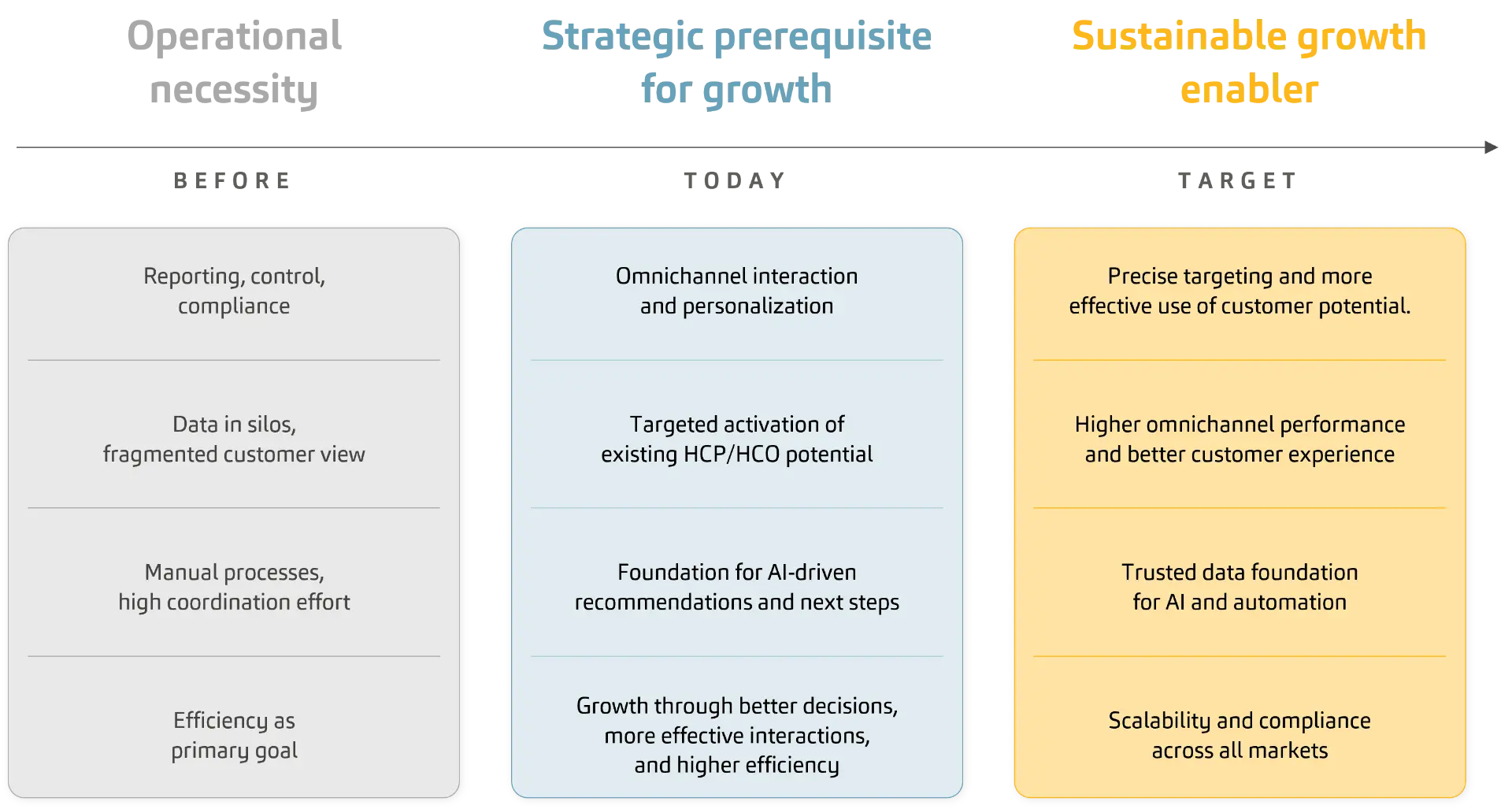
Commercial Data as a Growth Driver
Data quality is what determines whether that happens. Organizations that fail to consolidate customer information across disparate data sources will only partially recognize their potential – and will manage it even less effectively. Commercial Data is not an IT issue. It is a lever for the quality of commercial decisions.
Fragmented Data Landscapes Cost More Than Efficiency
In many companies, master data, CRM information, consent management, and external reference data remain scattered across countries, business units, and multiple systems. The causes are structural. Data maintenance was frequently outsourced, acquisitions left behind system silos, and ownership of data processes is rarely clearly defined. The result: inconsistent customer profiles, duplicate records, incomplete interaction histories, and high manual coordination overhead. CRM projects expose this gap between self-perception and reality time and again.
What used to cost primarily efficiency has become a strategic risk. Modern omnichannel models and data-driven sales approaches only work reliably when master data is current, consistent, and trustworthy. Without a foundation that enables cross-functional visibility, audience management, personalization, and Consent Preference Management remain fragmented.
AI Makes Data Quality Business-Critical
Generative AI and Agentic AI raise the stakes for data quality. Poor data no longer just produces faulty analyses – it can drive wrong decisions and actions, and AI systems amplify those weaknesses faster and more broadly than any prior technology.
When systems are recommending next steps, setting priorities, or initiating concrete actions, the data foundation becomes a prerequisite for trust, compliance, and business success. The question is no longer whether data is good enough for reporting. It is whether the data is robust enough for the decisions and processes that AI prepares or supports.
A modern Commercial Data architecture connects three layers: central master data management for HCP and HCO data, Commercial Execution in the CRM, and external market and reference data. Their integration is what enables a consistent view of customers, potential, and interactions. Technology alone is not enough – what matters equally is a clear target picture for the data model, ownership, and governance.
The practical impact is immediate. More precise audience management, enterprise-wide Consent Preference Management, stronger omnichannel performance, greater scalability of international business models, and a solid foundation for AI applications. Commercial Data becomes the enabler for more effective customer interactions and faster decisions.
Using CRM Transformations as a Strategic Inflection Point
The ongoing transformations around Veeva Vault CRM and Salesforce Life Sciences Cloud give many pharmaceutical companies a natural opportunity to reassess their Commercial Data architecture. The critical move is to treat this not as a technical migration but as a strategic inflection point – one that can eliminate existing weaknesses and fundamentally realign the data model, governance, and operating model for the long term.
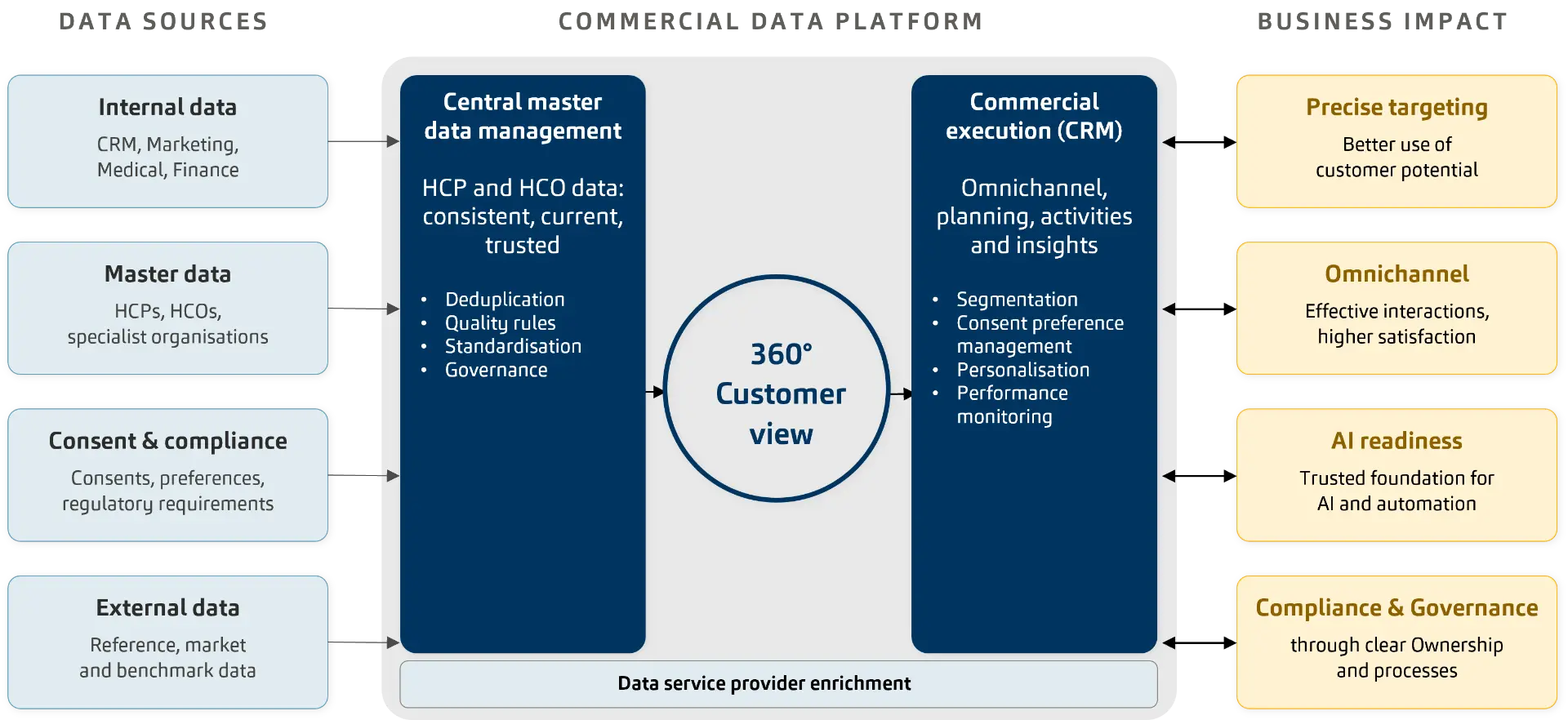
Modern Commercial Data Architecture: Integrate – Govern – Grow
A vendor-independent assessment provides clarity on where the largest gaps are, which priorities make sense, and which investments will actually deliver impact. Key questions: Is a data strategy in place with an adequate time horizon? How is the current system landscape structured for sales data and financial data? Where are the largest inefficiencies and untapped opportunities? Answering those questions turns a system decision into a robust foundation for investment choices.
Conclusion
Commercial Data is no longer purely an IT concern. It is becoming the foundation for growth through better commercial decisions, for more effective customer engagement through omnichannel excellence, and for the successful application of AI in the pharmaceutical sector. Companies that advance their data landscape strategically now are building not just a better analytics base – they are positioning themselves for faster, better decisions with demonstrable competitive advantage. The question is not whether to invest in Commercial Data. It is whether the existing data foundation is already equipped to meet the demands of the years ahead.
Authors
Would you like to learn more about this topic or discuss individual challenges?
Our contacts are available for a personal consultation.