


What the transition away from SAP Enable Now means for life sciences companies
SAP transformations have generated extensive training libraries over the years. Thousands of learning materials, carefully built, maintained and adapted to regulatory requirements. This knowledge base has supported and enabled the introduction and adoption of new systems and processes. However, AI has long been making inroads into the training environment too, and the technological foundation underpinning these extensive knowledge bases is now reaching its end of life.
Since 2025, the availability of new SAP Enable Now licences has been significantly restricted, and support will end in November 2030. The successor solution is already available: WalkMe Learning Arc, a generative AI-based suite for creating, delivering and managing training materials. For companies in the life sciences, pharmaceuticals and chemicals industries, this raises a question that is strategic in nature, even if it arrives in a technical wrapper: what happens to the training libraries that have been built up over the years, and how will the adoption of newly introduced solutions and applications be supported going forward?

From process guidance to knowledge transfer
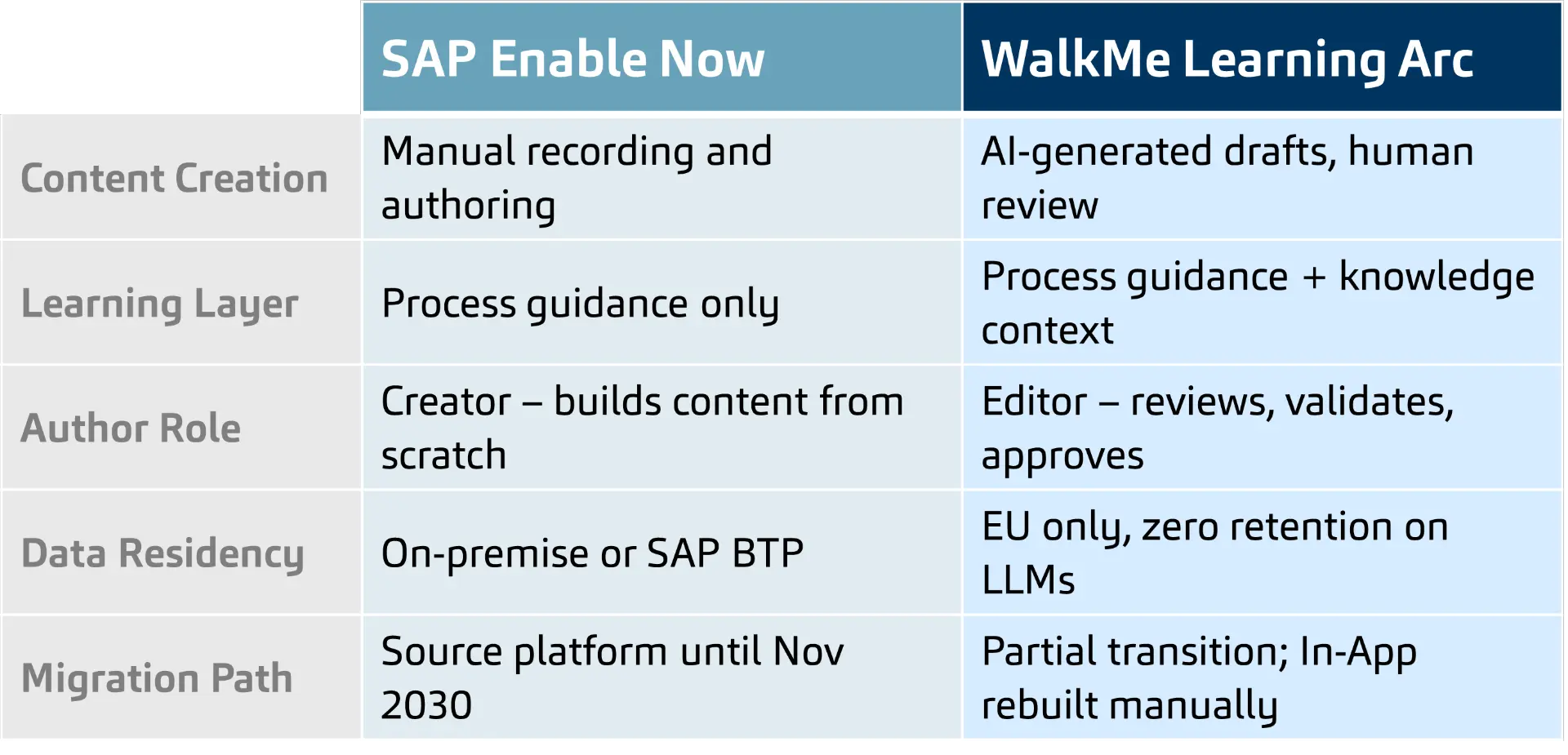
A comparision of SAP Enable Now and WalkMe Learning Arc
The logic of SAP Enable Now has largely been process-oriented: users were guided step by step through how to complete tasks and navigate workflows. These training elements could be embedded as trackable units within a learning management system, enabling the regulatory-compliant documentation of training completion. WalkMe extends this approach to include the knowledge layer. It informs users during task execution about why certain rules apply, what context sits behind a process step, and which compliance requirements are relevant. The combination of WalkMe as a classic Digital Adoption Platform with the new WalkMe Learning Arc as an AI-powered authoring suite creates an integrated offering that connects in-the-flow process guidance with embedded learning formats.
In regulated environments where data integrity, release logic and GxP compliance are operational realities, this is more than a didactic upgrade. A user working in regulated processes who is guided through a release procedure in SAP, for example, and who simultaneously understands the requirements behind it, will make better decisions, make fewer errors, and be better placed to respond in an audit. The divide between digital enablement and structured knowledge transfer is dissolved.
The shift in roles: from creator to editor
Those who produce training materials in SAP Enable Now today act as authors in the traditional sense: they replicate processes, record workflows, structure content and design the learning journey from scratch. This is time-intensive, requires close process knowledge and explains why organisations with large libraries have spent years building dedicated authoring teams or engaging external capacity.
WalkMe Learning Arc fundamentally changes this process. Generative AI takes over the creation of content drafts: based on a description, a process flow or an existing template, the system generates structured content in minutes. What changes is not the need for human expertise, but where that expertise is directed. The author's role becomes that of an editor: reviewing what the AI has produced, assessing factual accuracy, adding professional judgement and ensuring that published content meets both internal and regulatory requirements.
This control function is not an optional safeguard. AI-generated content may be inaccurate, and it has no knowledge of a company's internal procedures or current system configuration. In a GxP environment, unreviewed output is unacceptable. Therefore, the efficiency gains of the new platform only materialise where investment in new competency profiles keeps pace: authors who can professionally assess AI outputs and take editorial responsibility for them.
For companies in regulated industries, a further aspect is relevant: WalkMe Learning Arc exclusively processes data within the EU, does not use customer data to train public models and operates on a human-in-the-loop basis, whereby AI-generated drafts must be reviewed and approved by an author before publication. This is not standard practice across the market. For organisations managing GxP-relevant content or clinical process documentation, however, it is a prerequisite for deployment.
What the transition involves
Firstly, a full migration of existing content is only partially feasible from a technical standpoint, and is not usually a sensible strategy either. Established training libraries often contain a significant amount of material that is no longer used or reflects outdated processes, as well as content created for roles that no longer exist in their original form. Transferring this content would consume resources without providing any benefit. Therefore, a usage analysis of the existing library is a prerequisite for any transition planning.
Secondly, the platform change requires infrastructure decisions involving IT and contract management from an early stage. These decisions must cover user management, translation requirements, and the tools that the authoring team will require during the transition period.
Thirdly, regulated content operates under its own set of requirements. GxP-relevant training materials, instructions for safety-critical processes and compliance documentation cannot simply be transferred. They must be reviewed for content accuracy, and revalidated where necessary, with Quality and Regulatory Affairs involved throughout. This is an organisational task, not an IT one, and it requires commensurate lead time.
What to do now
Take stock before transitioning. What content exists? What is actively used? What carries compliance relevance? A structured inventory, based on usage data from SAP Enable Now Analytics, will inform decisions on what to migrate, what to rebuild, and what to leave behind.
Adjust roles and competencies early. The new way of working involves generating and editing content through AI rather than building it manually, so new skills are required within the authoring team. Investing in upskilling early on means the team can capture the efficiency gains of the new platform from day one.
Use parallel operation as a transition strategy. SAP Enable Now and WalkMe Learning Arc can be run in parallel for a defined period. This allows for a phased transition: new content can be created on the new platform, critical existing content can be migrated in an orderly fashion, and the team can become familiar with the new way of working.
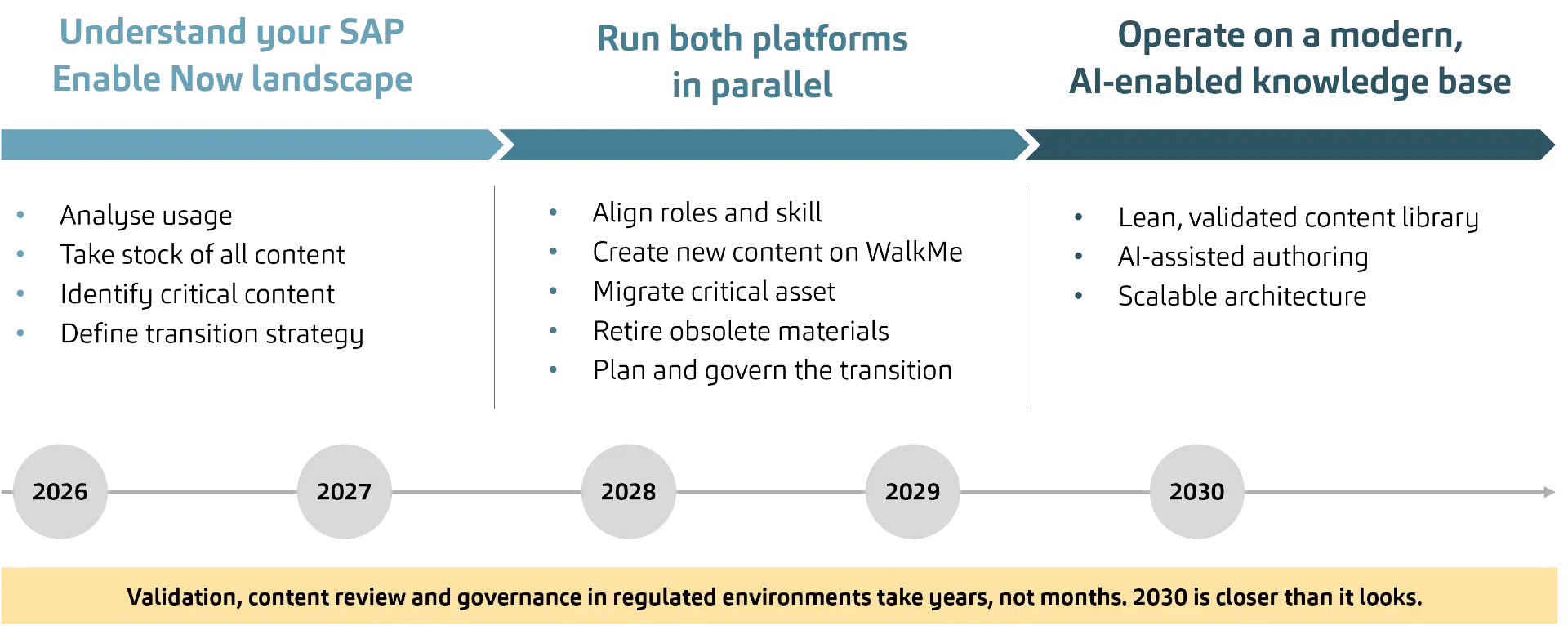
From now to transition: Plan your move from SAP Enable Now to WalkMe
Conclusion
There is little alternative to transitioning from SAP Enable Now to WalkMe Learning Arc as an integrated knowledge platform. This transition should be a strategic priority for life sciences, pharmaceutical and chemicals companies, as enablement is an integral part of the operational and compliance-relevant infrastructure in regulated environments. WalkMe Learning Arc offers the opportunity to modernise this infrastructure, significantly reducing content creation effort and enabling closer integration of process guidance and knowledge transfer, as well as providing an architecture that can handle growing system complexity.
Authors
Would you like to learn more about this topic or discuss individual challenges?
Our contacts are available for a personal consultation.